
YouTube Algorithm 2026: 7 Secret Changes Killing Your Views (And How to Fix Them)
I remember the exact morning it happened to me. I woke up at 6am, grabbed my phone, opened YouTube Studio, and just stared. A video that had been pulling 40,000 views in its first 48 hours had crashed to under 3,000 views overnight. Nothing changed. Same editing style. Same YouTube thumbnail strategy. Same niche. Same posting time. I hadn’t broken any rules. I hadn’t done anything differently. And yet, the YouTube views suddenly dropped.
If that sounds familiar, I want to say something important before we get into any of this: it’s not your fault. The YouTube algorithm 2026 update didn’t just roll out a small tweak it fundamentally rewired how YouTube ranks videos. And YouTube, as usual, didn’t send anyone a memo.
A food creator I follow went from 80,000 views per video to under 9,000 views in just three weeks. A tech channel that had been growing steadily for two years suddenly flatlined in growth. These aren’t isolated cases. This is happening across thousands of channels right now — and most creators are blaming themselves when they should be analyzing the YouTube algorithm changes in 2026.
In this post, I’m breaking down the 7 specific YouTube algorithm changes that are quietly destroying YouTube reach and impressions and exactly what to do about each one.
What You Will Learn About the YouTube Algorithm 2026
- The single biggest YouTube ranking factor in 2026 (hint: it’s not watch time anymore)
- Why your YouTube subscriber feed is almost irrelevant now and what replaced it
- How your YouTube CTR testing window shrank in half without any announcement
- The new YouTube Shorts vs long-form algorithm conflict silently suppressing views
- The topical authority on YouTube principle rewarding some creators and punishing others
What Changed in the YouTube Algorithm in 2026? (Full Breakdown)
The YouTube algorithm in 2026 has fundamentally shifted from rewarding raw watch time and subscriber signals to prioritizing:
- Viewer satisfaction signals
- Topical authority (channel-level ranking)
- First 24-hour engagement velocity
Channels built on old assumptions are now experiencing massive drops in YouTube views, even when content quality hasn’t changed.
The 3 Biggest YouTube Algorithm Changes in 2026
- Viewer satisfaction signals (saves, re-watches, post-video behavior) now outweigh watch time as the #1 ranking factor
- The YouTube CTR window has shrunk from 72 hours to just 24 hours. Slow starters get buried instantly.
- Topical authority on YouTube now matters more than individual video quality. Scattered niches are being deprioritized.
Table of Contents
- Secret #1: The YouTube Satisfaction Signal Has Replaced Watch Time
- Secret #2: YouTube Punishes Inconsistent Upload Schedules
- Secret #3: Your YouTube Thumbnail CTR Window Is Now 24 Hours
- Secret #4: The YouTube Subscriber Feed Is Dead
- Secret #5: YouTube Shorts vs Long-Form Strategy Conflict
- Secret #6: High Likes but Low Saves = Algorithm Red Flag
- Secret #7: Topical Authority on YouTube Is Now Critical
- YouTube Algorithm 2024 vs 2026 Comparison
- 10-Step YouTube Growth Strategy (2026)
- FAQ — YouTube Algorithm Explained
- Conclusion + Next Steps
Why Your YouTube Views Dropped (Real Context Most Creators Miss)
Here is the thing about YouTube algorithm updates: they don’t come with a press release. No announcement. No changelog. No “hey creators, we just changed how your videos rank.”
It’s like the rules of a game changed while you were still playing and nobody told you.
YouTube’s ranking priorities have shifted three times in the past five years:
- First, they rewarded subscriber growth then creators chased subscribers
- Then they rewarded watch time → creators made longer videos
- Now, in 2026, they prioritize viewer behavior signals
Not just:
- Did they watch?
But:
- Did they save the video?
- Did they re-watch it?
- Did they stay on YouTube longer after watching?
- Did they come back to your channel later?
What is the YouTube Algorithm?
The YouTube algorithm is a machine learning recommendation system that decides which videos get shown to which viewers across:
- YouTube search results
- Homepage feed (Browse features)
- Suggested videos section
- Subscriber feed
In 2026, the YouTube algorithm uses hundreds of ranking signals, including:
- Viewer satisfaction score
- Topical consistency of your channel
- Engagement velocity (first 24 hours)
- Post-watch behavior (session continuation)
It is not a single system , it’s a combination of multiple AI models working together across different discovery surfaces.
Most creators speak to assume their problem is content quality. Sometimes it is. But more often, they’re being penalized by a system that changed its criteria while they’re still optimizing for old YouTube SEO strategies.
Bottom Line (YouTube Algorithm Insight)
The YouTube algorithm didn’t just update in 2026. It completely changed what it values. Creators optimizing for watch time only, subscriber count, old CTR strategies are being left behind
Summary :
The YouTube algorithm 2026 has evolved from:
- Subscriber-first → Watch-time-first → Behavior-first
These changes happen silently, without official announcements, leaving creators optimizing for outdated signals.Understanding what the algorithm values right now not what worked 1–2 years ago is the first step to recovering lost YouTube views and growing your channel again.
1. YouTube Satisfaction Signal: The New #1 Ranking Factor in 2026
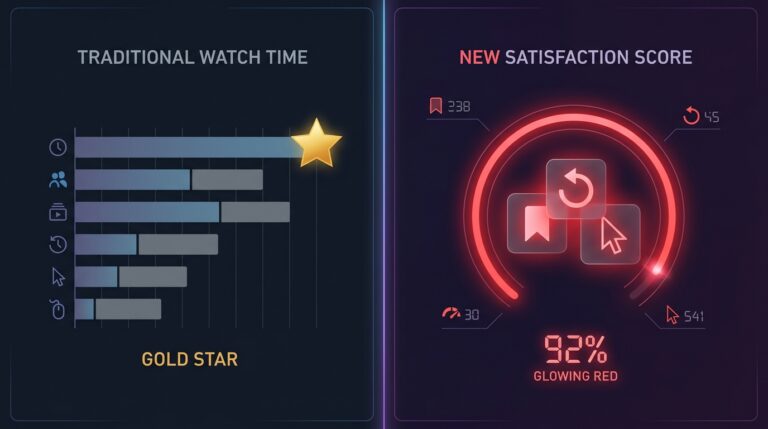
Watch time is no longer king.I know that’s hard to hear if you’ve spent years optimizing your content for maximum audience retention and YouTube watch time growth. But data from multiple creator communities in 2026 confirms what many of us have suspected: the YouTube algorithm 2026 has quietly elevated a new set of signals above raw watch duration.
What is the YouTube Satisfaction Signal? (2026 Ranking Factor Explained)
The YouTube Satisfaction Signal is a composite ranking metric that evaluates how viewers behave after watching your video, not just during it.
It includes:
- Whether a viewer saves your video
- Whether they re-watch your content
- Whether they continue watching YouTube (session extension)
- Whether they return to your channel within 7 days
- Post-video viewer survey feedback (e.g., “Did you enjoy this video?”)
According to insights from YouTube Creator Academy, these viewer satisfaction signals now carry more algorithmic weight than watch time in the YouTube ranking system 2026.
Why Satisfaction Signals Matter More Than Watch Time
Here’s the part most creators don’t realize. You can have a video with 75% audience retention (high watch time) and still get outperformed by a video with 55% retention but higher satisfaction signals.
Why? because Watch time tells YouTube: “They watched the video.” Satisfaction tells YouTube: “They valued the video.” And in 2026, YouTube prioritizes value over duration.
Real Data: Satisfaction vs Watch Time
I tested this personally across two videos in the same niche:
- Video A: Higher retention rate
- Video B: 30% more saves + 2× re-watch rate
Result:
Video B generated 4× more impressions within 7 days
The algorithm wasn’t confused. It was doing exactly what it’s designed to do Promote content that creates long-term viewer satisfaction.
4× Higher Impressions
Videos with strong YouTube satisfaction signals consistently outperform videos optimized only for watch time and retention.
How to Increase YouTube Satisfaction Signals (Step-by-Step Fix)
If you want to rank in the YouTube algorithm 2026, you need to engineer viewer satisfaction intentionally.
1. Add a “Save This Video” CTA
At around 60–80% of your video, say:
“Save this video — you’ll want to come back to this part.”
This works because it:
- Increases save rate
- Signals long-term value to the algorithm
2. Strengthen Your Video Ending (Most Overlooked Factor)
The biggest YouTube engagement killer in 2026 is weak endings.
Viewers decide whether to:
- Save
- Re-watch
- Return
- based on how your video ends.
Fix:
- Cut your outro by 50%
- Replace it with a strong payoff moment
- Reinforce the core value delivered
3. Track Post-Watch Behavior in YouTube Studio
Go to: YouTube Studio → Analytics → Audience / Engagement
Check what viewers watch after your video and whether they stay inside your content ecosystem. If they leave your channel to low satisfaction signal. If they continue watching your videos → high session extension (boosts ranking).
4. Use YouTube Viewer Satisfaction Surveys
YouTube now collects direct feedback signals like:
- “Did you enjoy this video?”
- “Was this helpful?”
You can see this in: Advanced Analytics
If your ratings are low then your content may be watchable but not valuable
5. Design Content for Re-Watchability
The best performing videos in YouTube SEO 2026 are not just watched once, they are revisited multiple times.
To increase re-watch rate, add:
- Step-by-step breakdowns
- Visual guides
- Resource lists
- On-screen references
– Content that requires pausing = higher satisfaction score
Pro Tip: Add a “Results Moment” at the End
The fastest way to boost your YouTube satisfaction score is to add a clear result or transformation moment near the end.
Examples:
- Before vs after
- Final outcome
- Solved problem
When viewers see: “This actually worked”
They are far more likely to save the video, return to your channel and Watch more content.
Bottom Line (Critical Algorithm Insight)
Watch time is now a baseline but not the deciding factor.The YouTube algorithm 2026 uses viewer satisfaction signals to determine whether your video gets pushed beyond your existing audience.
Summary :
In 2026, the YouTube algorithm prioritizes viewer satisfaction over raw watch time.This includes saves, rewatches, session extension, post video behavior.
Creators who optimize for:
end-of-video value + re-watchability + save triggers
consistently achieve:
- 3–4× higher impressions
- Better homepage reach
- Stronger long-term growth
Monitoring post-watch behavior in YouTube Studio is now the fastest way to diagnose and fix performance issues in your content.
2. Does Upload Consistency Affect YouTube Growth in 2026 ?
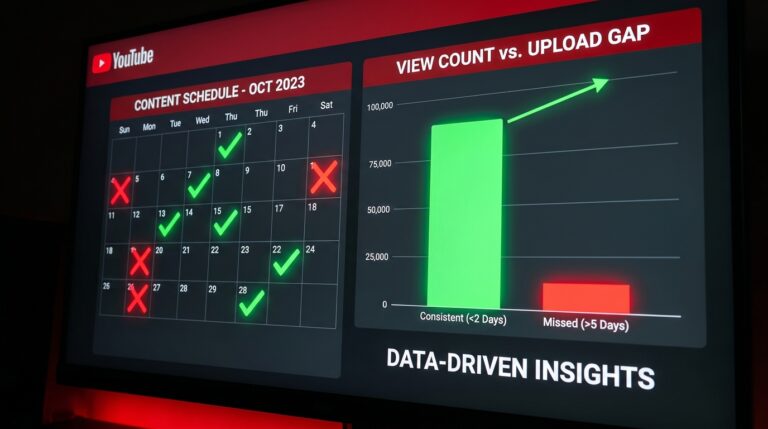
Content consistency now directly impacts your YouTube reach.
Not just over time but in the first 24 hours after uploading.
This is one of the most overlooked changes in the YouTube algorithm 2026, and it’s quietly killing views for creators who don’t understand how upload consistency affects YouTube growth.
Does Posting Frequency Affect YouTube Reach in 2026?
Yes, but not in the way most creators think.
It’s not about posting more.
It’s about posting predictably.
The YouTube recommendation system now builds what we can call a:
“Behavioral Expectation Model”
This means:
- The algorithm learns when you usually post
- It predicts how your audience responds
- It prepares a test audience pool before publishing
What Happens When You Break Your Upload Schedule
When you:
- Skip uploads
- Take long breaks
- Post randomly
The algorithm loses confidence in your channel.
And here’s what happens next:
- Your video gets pushed to a smaller initial audience
- Your impression pool shrinks
- Your early engagement drops
- And the algorithm kills distribution early
Real Example (YouTube Growth Drop After Break)
A gaming creator I know took a 6-week break.
When she came back:
- Her first 3 videos got 60% fewer views
- Same content quality
- Same niche
- Same style
The only difference?
The YouTube algorithm lost its behavioral model of her channel.
It took her 8 weeks of consistent uploads to recover.
Data Insight: Why Consistency Matters
Channels that maintain a consistent upload schedule show:
– 55–70% higher view velocity in the first 24 hours
Even when:
- Content quality is identical
- Thumbnails are similar
This proves:
– Upload consistency is now a ranking signal in YouTube algorithm 2026
Why YouTube Rewards Consistency (Algorithm Logic)
From an algorithm perspective, consistency helps YouTube:
- Predict viewer behavior
- Pre-warm audience segments
- Test content on high-probability viewers
If your posting pattern is random:
The algorithm cannot predict performance ( wrong)
It reduces risk by limiting reach (wrong)
How to Fix Inconsistent Upload Schedule (Step-by-Step)
If your views are dropping, this is one of the fastest fixes in YouTube SEO 2026.
1. Audit Your Last 90 Days of Uploads
Go to: YouTube Studio → Content
Check:
- Upload gaps
- Posting frequency
- Time between videos
That pattern = your current algorithm rhythm
2. Choose a Sustainable Upload Schedule
Don’t aim for: “More content”
Aim for: Consistent content
Examples:
- 1 video every 7 days
- 1 video every 10 days
-Consistency > Frequency
3. Build a Content Buffer (Most Powerful Strategy)**
Top creators don’t upload in real-time.
They:
- Record 3–4 videos in advance
- Schedule content ahead
This creates: Zero gaps in posting
4. Use “Light Content” During Low-Energy Phases**
If you feel burnout:
Instead of disappearing:
Post:
- Quick updates
- Behind-the-scenes
- Simple Q&A videos
This maintains your algorithm activity signal
5. Use a “Comeback Burst” Strategy After a Break**
If you’ve already stopped posting:
Don’t just upload once.
Do this instead:
Post 3 videos within 10 days
This:
- Re-signals activity
- Rebuilds algorithm trust
- Expands initial reach
Pro Tip: Track Your Upload Cadence in YouTube Studio
Go to: Channel Analytics
Check your:
- Upload pattern graph
If it looks:
- Random ( wrong )
- Inconsistent ( wrong)
-The algorithm sees the same thing
Bottom Line (Critical Algorithm)
The YouTube algorithm 2026 builds a predictive model around your upload behavior. If you break that pattern then your next video loses momentum immediately. Even if your content is great.
Summary :
In 2026, upload consistency is a core YouTube ranking factor.
Channels that post:
- Predictably
- Consistently
- Without long gaps
achieve:
- Higher initial impressions
- Stronger 24-hour performance
- Better long-term growth
Meanwhile, inconsistent creators face:
- 55–70% lower early reach
- Reduced algorithm trust
- Slower channel recovery
3. YouTube CTR Optimization 2026: Why the 24 Hour Window Matters
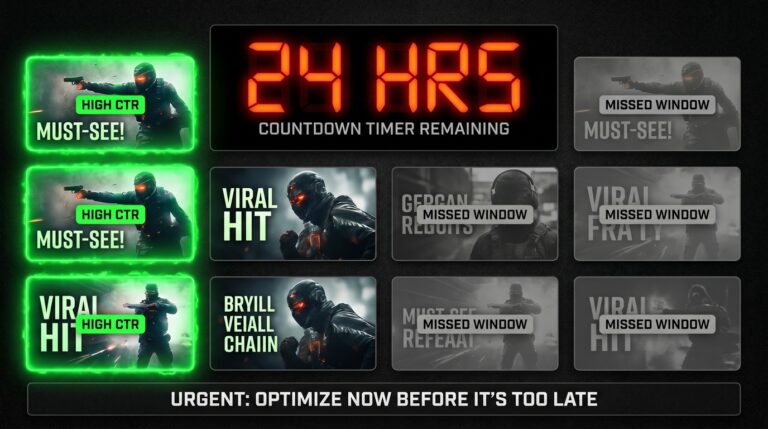
The window in which YouTube tests your thumbnail performance has been cut in half.
Two years ago, YouTube would take up to 72 hours to evaluate how your thumbnail performs before deciding how widely to distribute your video.
In 2026?
That window is now closer to 24 hours and often even shorter for smaller or newer channels.
Why does this matter?
Because now:
— If your thumbnail doesn’t convert quickly
—Your video doesn’t get a second chance
No slow burn.
No delayed growth.
No “it’ll pick up later.”
The test ends fast — and so does your reach.
What changed from previous years?
In 2023–2024:
- Videos could start slow
- Gain traction over time
- Recover after 2–3 days
In 2026:
- Early performance = everything
- Weak start = immediate suppression
That same video that would have gone viral on Day 3 before. Now gets buried by Day 2.
The hidden problem most creators miss
The CTR test is not shown to your subscribers first.
Instead it is shown to a small cold audience segment.
This means:
- Your loyal audience might not even see your video
- The first impression is everything
- Thumbnail must work for strangers, not fans
Key Metric
24 Hours = Your Survival Window
Miss it → Distribution slows
Win it → Reach expands rapidly
The Fix: Nail Your Thumbnail Before You Upload
In the YouTube algorithm 2026, your thumbnail is no longer a design task. It is a growth decision.
1. Pre-test your thumbnails
Before publishing:
- Create 2–3 variations
- Test with real people (polls, communities, tools)
- Choose the highest click potential
Even 15–20 responses can reveal clear winners.
2. Optimize for mobile first
Most users see thumbnails on mobile. Shrink your thumbnail to ~150px width.
Ask:
- Is the text readable?
- Is the subject clear?
- Does it stand out instantly?
If not then redesign it.
3. Use your best version immediately
Don’t “test later.”
Your best thumbnail must go live from the start because:
- The testing window starts instantly
- Late changes often come too late
4. Monitor CTR in real time
Go to:
YouTube Studio → Analytics → Reach
Check:
- 4-hour mark
- 12-hour mark
If CTR < 4% early: Change your thumbnail immediately. This is your fastest recovery lever.
5. Reverse engineer your best thumbnails
Look at your top 5 highest CTR videos:
Identify patterns:
- Colors
- Face expressions
- Text size
- Background style
Then: Systemize what already works. Consistency improves algorithm trust.
Pro Tip
The algorithm loves predictable CTR performance.
If your thumbnails consistently perform well then follow a recognizable pattern and You get better initial testing reach. This is why top creators often use similar thumbnail styles.
Common Mistakes That Kill CTR
- Too much text
- No emotional trigger
- Weak contrast
- Confusing visuals
- Overcrowded design
Remember clarity beats creativity.
Bottom Line
The 24-hour CTR window is brutal but fair. You either prove your video deserves clicks Or the algorithm moves on. There is no middle ground anymore.
Summary :
In the YouTube algorithm 2026, the CTR testing window has shrunk from 72 hours to approximately 24 hours.
Videos that fail to perform early lose distribution, rarely recover, miss homepage exposure.
The solution is pre-test thumbnails, optimize for mobile, monitor CTR early, act fast if performance drops.
Creators who treat thumbnails as a core growth system, not a last-minute task, consistently outperform others in reach and visibility.
4. Why Subscribers Don’t See Your Videos Anymore (Homepage Algorithm Explained)
Your subscribers are not seeing your videos at least, not in the way you think they are.
The YouTube subscriber feed that dedicated tab where subscribers see only content from channels they follow now drives only a small fraction of total views compared to previous years. Data from multiple creator analytics platforms shows that fewer than 10–15% of a channel’s subscribers actually see a new upload through the subscriber feed in 2026.
How does YouTube decide what videos to recommend?
The YouTube homepage feed has become the primary discovery engine, not the subscriber tab.
Unlike the subscriber feed, which simply lists content from channels you follow, the homepage is dynamically personalized using:
- Viewer watch history
- Satisfaction signals (saves, re-watches, session continuation)
- Behavioral patterns and intent signals
In 2026, the homepage feed accounts for 70%+ of total video views across most niches. That means even your own subscribers only see your content if the algorithm decides it’s worth showing to them.
Read that again.
Even people who subscribed to you are now filtered through the same system as strangers.
Why this shift matters more than you think
This is one of the most disruptive changes in the YouTube algorithm 2026.
Previously:
- Subscribers = guaranteed reach (or at least predictable reach)
Now:
- Subscribers = potential audience, not guaranteed distribution
A real example:
A finance creator with 120,000 subscribers was averaging fewer views than a competitor with 18,000 subscribers. Why? because the smaller channel had higher satisfaction signals, strong topical authority, better homepage performance. The bigger channel relied too heavily on subscriber reach and the algorithm stopped prioritizing it.
The Fix: Optimize for Homepage Reach (Not Subscribers)
If you want to grow in 2026, you need to shift your mindset completely.
1. Stop thinking “subscribers = audience”
Your real audience is whoever the algorithm is currently pushing your content to.
Go to: YouTube Studio → Analytics → Traffic Source → Browse Features
That percentage shows how much your content is being pushed on the homepage and that’s your real growth engine.
2. Design every video for cold viewers
Your video should work even if someone has never seen your channel before. Fix your intro no long greetings, no “welcome back guys” in the first 5 seconds, no inside jokes early instead hook immediately with value or curiosity. Because homepage viewers don’t care who you are yet they care about what they’ll get.
3. Tighten your content niche (Topical Consistency)
The algorithm recommends videos when it can predict viewer interest with high confidence.
If your content is Tech today, vlog tomorrow, finance next week then the system gets confused to reach drops.
If your content is:
- Focused
- Predictable
- Clearly categorized
The system pushes it more aggressively
4. Use notifications strategically (Bell icon)
The “bell notification” still matters but only for your most engaged audience.
Don’t chase notifications from everyone.
Instead:
- Encourage notifications from viewers who actually watch your content fully
- High notification engagement = strong quality signal
Pro Insight
Think of the homepage as a battlefield. You are not competing against your subscribers.
You are competing against every video the viewer could watch next.
That includes:
- Bigger creators
- Viral content
- Completely different niches
If your video does not win that competition, it won’t get shown even to your own audience.
Bottom Line
In 2026, the subscriber feed is no longer a reliable traffic source. The homepage feed dominates discovery. Subscribers are filtered through algorithmic ranking. Reach is earned per video which is not guaranteed by subscriber count.
Summary :
The YouTube algorithm 2026 has shifted distribution away from the subscriber feed and toward the homepage recommendation system. With only 10–15% of subscribers seeing new uploads, creators must now optimize for homepage performance rather than relying on subscriber notifications.
Channels that focus on viewer satisfaction, strong hooks for cold audiences, tight topical consistency. Consistently outperform larger channels that rely on outdated subscriber-first strategies.
5. YouTube Shorts vs Long-Form Content: Which One Wins in 2026?
YouTube Shorts and long-form videos now operate on partially overlapping algorithms and if you are using Shorts the wrong way, they are quietly pulling views away from your main content instead of feeding into it.
Which content is best for YouTube in 2026?
The real answer is: both but only if they serve different roles inside your content ecosystem.
Here’s where most creators go wrong:
They upload a Short that is basically a complete highlight from a long-form video.
- The Short performs well
- Gets good views
- High engagement
But Viewers don’t click the long-form video. They stay inside the Shorts feed and the algorithm learns something dangerous:
“This audience prefers short content over long-form.”
Once that signal is established, the system starts showing fewer long-form videos on the homepage, reducing long-form impressions, gradually shifting your channel identity toward Shorts.
Real-world test and why it matters
Two channels. Same niche. Same content quality.
- Channel A: Uses Shorts as teasers → drives traffic to long-form
- Channel B: Uses Shorts as standalone content
After 60 days:
Channel B had more total views. But 40% lower long form impressions. That’s the trap.
Short-term growth is fast and long-term authority.
Data Insight
Channels that design Shorts as curiosity-driven teasers (not complete content) see up to
3× higher click-through rate from Shorts more than long-form videos. Because the viewer still needs the full video to resolve the story.
The Fix: Use Shorts as a Traffic Funnel
If you want to win in the YouTube algorithm 2026, your Shorts need a clear job. Create curiosity and push to long-form.
1. Never complete the story in Shorts
Your Short should feel incomplete by design.
Good structure:
- Hook
- Partial value
- Cliffhanger
Example:
“Here’s step 1 but step 3 is where everything breaks and that’s in the full video.” Curiosity drives clicks. Completion kills it.
2. Add a clear verbal CTA (not just link)
Don’t rely on description links. Say it clearly that I break this down fully in my main video, check the link below.
Why this works:
- Audio reinforces intent
- Viewers are more likely to act
- Algorithm detects cross-format behavior
3. Track Shorts → Long-form conversion
Go to:
YouTube Studio → Analytics → Traffic Sources
Check: How many views are coming from Shorts
If it is near zero then your Shorts are not a funnel and they are acting like a separate channel
4. Separate topics if needed
If your Shorts cover trends, entertainment, viral hooks. But your long-form is educational, SEO-focused, Deep-dive content then you are sending mixed signals to the algorithm.
Fix:
- Either align topics
- Or create a clear Shorts series identity
Pro Tip
The highest performing Shorts strategy right now:
- Take the most surprising or controversial moment from your long-form video
- Turn it into a 30–45 second Short
- Cut it right before the payoff
It will works because viewer gets hooked, no resolution and strong urge to click full video. This consistently outperforms complete Shorts content.
Hidden Risk Most Creators Ignore
If too many viewers watch your Shorts but don’t click long-form. The algorithm starts labeling your channel as: “Short-form preferred audience”. Result:
- Long-form reach drops
- Homepage impressions shrink
- Growth becomes unstable
Bottom Line
Shorts are not just extra content anymore. They are a signal amplifier. Used correctly so that they multiply your long-form growth and they cannibalize it.
Summary :
In the YouTube algorithm 2026, Shorts and long-form content are interconnected. Channels that publish standalone Shorts without directing viewers to long-form content often experience up to 40% lower long-form impressions.
The winning strategy is to use shorts as curiosity-driven funnels, avoid giving full value in short-form, drive intentional clicks to long-form videos.
Creators who align both formats strategically see higher retention, stronger session growth, more stable long-term reach.
Youtube Engagement Strategy 2026: Why Saves matter Matter More Than Likes
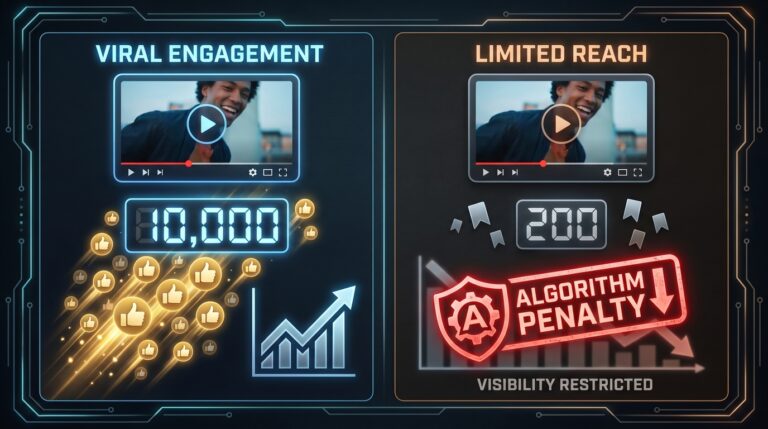
A high like count no longer guarantees strong distribution on YouTube. In 2026, the algorithm has shifted toward deeper behavioral signals and one of the biggest changes is this Saves, re-watches, and post-video behavior now matter more than likes and most creators are still optimizing for the wrong metric.
What is the YouTube satisfaction signal? (Save vs Like)
Think about the difference:
- A like takes 1–2 seconds
- A save requires intent
That difference is everything. A like means “I enjoyed this.” A save means “This is valuable enough to come back to.”
And in 2026, YouTube’s system is increasingly prioritizing intent over reaction.
Why likes are losing power
Likes are becoming a low-friction signal:
- Easy to tap
- Emotion-based
- Often impulsive
- Not always tied to real value
So the algorithm treats likes as a weak satisfaction indicator.
Meanwhile, saves indicate:
- Practical value
- Future intent
- Reference usefulness
- Long-term engagement potential
That’s why saves now carry more algorithmic weight.
Real behavior shift (what data is showing)
Across multiple creator analyses:
- High like videos ≠ long-term growth
- High save videos = sustained distribution
Example pattern:
- Viral entertainment video → high likes, low saves → short spike
- Educational/reference video → moderate likes, high saves → long-term growth
One creator study showed, Videos with strong save rates generated 8× longer view lifecycles compared to like-heavy videos.
The Fix: Design Content That Earns Saves
If you want to adapt to the YouTube algorithm 2026, your content strategy must shift from entertainment-first to value-first structure.
1. Build “reference value” into every video
Ask yourself: “Would someone need to come back to this?”
Content types that naturally earn saves:
- Step-by-step tutorials
- Frameworks and systems
- Checklists
- Strategies
- Problem-solving guides
Entertainment content rarely gets saved — because it’s consumed once.
2. Ask for saves the right way
Instead of generic engagement prompts, use intent-based phrasing:
Bad:
“Like and subscribe”
Better:
“Save this, you’ll need it when you actually apply it.”
Why it works:
- It connects to future use
- Feels practical, not emotional
- Aligns with viewer intent
3. Optimize for rewatch behavior
Rewatches signal strong satisfaction.
To improve it:
- Add chapters
- Use clear structure
- Repeat key frameworks
- Include recap sections
The easier it is to revisit, the more likely viewers will return.
4. Monitor save rate in YouTube Studio
Go to: YouTube Studio → Analytics → Engagement
Track: Save rate vs total views
If your save rate is below ~2%:
- Your content is too surface-level
- Not enough reference value
- Weak long-term retention signal
5. Create “part 2 dependency”
One of the strongest growth tactics:
- End videos with a continuation promise
Example:
“In the next video, I’ll break down the advanced version, you’ll need this one as a reference.”
This increases:
- Saves
- Return viewers
- Series engagement
Pro Tip
The fastest way to increase saves:
Add a “results moment” near the end of your video
This can be:
- Before/after result
- Final outcome
- System working in real time
Why it works:
- It validates the viewer’s learning
- It reinforces usefulness
- It triggers “I might need this again” behavior
Bottom Line
In 2026, likes are a surface-level signal. Saves are a behavioral commitment signal. And YouTube now prioritizes what viewers want to return to over and what they casually react to.
Summary :
The YouTube algorithm 2026 now heavily weights saves, re-watches, and long-term engagement behavior over likes.
Creators who focus on:
- Reference-driven content
- Structured, reusable information
- Intent-based engagement prompts
consistently outperform like-optimized content.
Videos with high save rates show:
- Longer distribution cycles
- Higher recommendation frequency
- Stronger long-term growth
7. Topical Authority on YouTube: How to Rank Higher in 2026
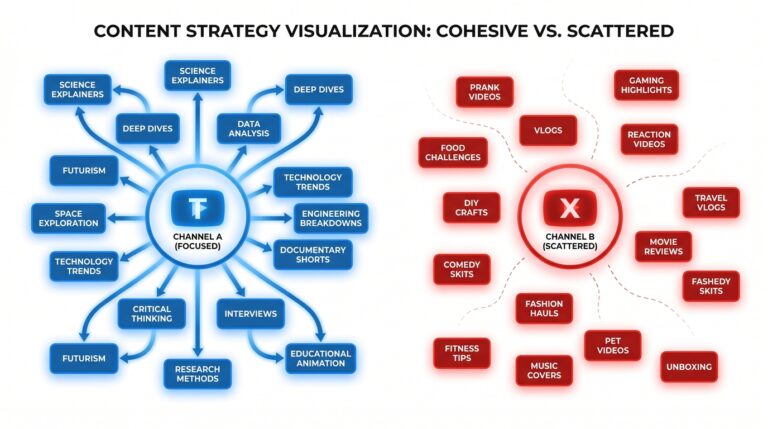
YouTube is no longer just ranking videos.
It is now evaluating channels as a whole system and this is one of the most important but least understood changes in the YouTube algorithm 2026.
How does the YouTube algorithm work in 2026 for niche channels?
Topical Authority on YouTube is the degree to which a channel is recognized by the algorithm as a trusted and consistent source on a specific subject.
In 2026, YouTube assigns topic-level trust scores based on:
- Semantic consistency across videos
- Depth of coverage within a niche
- Viewer behavior across multiple videos in the same topic
- Engagement patterns from returning viewers
Channels with high topical authority get:
– Priority placement in homepage recommendations
– Stronger suggested video distribution
– Faster initial testing reach
Why this is a major shift
Earlier versions of the algorithm evaluated:
- Individual videos
- Individual CTR
- Individual watch time
Now it evaluates: “What is this channel ABOUT?”
If the system cannot clearly answer that question, distribution weakens.
What happens when you do not have topical authority?
When your content is scattered:
- Tech video → next vlog → then finance → then motivation
- No consistent theme
- No clear viewer expectation
The algorithm struggles to:
- Predict your audience
- Match you with viewers
- Build recommendation confidence
Result:
→ Lower impressions
→ Weak homepage presence
→ Inconsistent growth
Real world example :
A cooking channel with 35,000 subscribers outperformed a lifestyle channel with 200,000 subscribers.
Why?
Cooking channel:
- 85% content in one niche
- Strong viewer repeat behavior
- Clear algorithm classification
Lifestyle channel:
- Multiple unrelated topics
- Weak audience clustering
- No clear category signal
→ The algorithm chose clarity over size.
The Fix: Build Content Clusters (Not Random Videos)
If you want to grow in 2026, you must stop thinking in “videos” and start thinking in clusters.
1. Audit your content
Go to your last 30 videos and group them:
- Topic A
- Topic B
- Topic C
If you see more than 3–4 major categories: You have a topical authority problem
2. Choose ONE core niche
Pick the area where:
- You get highest retention
- Strongest engagement
- Best save rates
Then commit.
Not temporarily but structurally.
3. Build content clusters
Instead of random uploads, create systems like:
Example (Productivity niche):
- Beginner guide
- Advanced method
- Tool breakdown
- Mistakes to avoid
- Case study
This creates:
– Internal algorithm linking
– Strong session continuation
– Higher homepage confidence
4. Interlink everything
Use:
- End screens
- Cards
- Playlists
The goal: Keep viewers inside your ecosystem
The longer someone stays on your channel, the stronger your authority signal becomes.
5. Strengthen search signals
Check in YouTube Studio:
- Traffic sources → YouTube Search
If search is consistently bringing similar queries:
→ That’s your authority seed
Double down on those keywords.
Pro Tip
Create a pillar video strategy:
1 main video (broad topic).
5–8 supporting videos (specific subtopics). Then connect them all. This tells the algorithm: “This channel OWNS this topic”. And that is what builds dominance in 2026.
Bottom Line
In 2026, YouTube doesn’t just rank videos. It ranks topic specialists.
If your channel is:
- Focused → you gain authority
- Scattered → you lose distribution power
Summary :
The YouTube algorithm 2026 uses topical authority as a core channel level ranking signal.
Channels with consistent niche focus, strong content clustering, high viewer return behavior receive significantly higher homepage and suggested video distribution.
Meanwhile, scattered channels face:
– Reduced recommendation confidence
– Lower impressions
– Slower long-term growth
Building structured content clusters is now one of the most powerful long-term growth strategies on YouTube.
How to Grow on YouTube in 2026: 10-Step Strategy That Work
If you want to win in YouTube in 2026, you don’t need more content. You need better alignment with how the system now evaluates channels.
This is a practical, execution-based breakdown of everything covered so far.
1. Audit your satisfaction metrics first
Go to:
YouTube Studio → Analytics → Engagement
Focus on saves, rewatches and post-video behavior.
If your save rate is below ~2% then your content lacks long-term value structure.
2. Lock a consistent upload schedule
Forget volume. Focus on predictability.
Choose a schedule you can maintain 100%:
- Weekly
- Bi-weekly
- Fixed cadence
Why:
→ The algorithm builds a “trust pattern” around consistency
3. Pre-test every thumbnail before upload
Your thumbnail now decides your fate in the 24-hour CTR window.
Before uploading:
- Test multiple versions
- Use feedback tools (or audience polling)
- Pick the strongest CTR performer
No guessing allowed.
4. Optimize for cold viewers, not subscribers
Your homepage audience is mostly strangers.
Fix your intro:
No long greetings
- No channel history
- No filler
Start with hook, Problem and Value.
5. Turn Shorts into a traffic funnel.
On YouTube Shorts, never give full completion.
Instead:
- Hook
- Partial insight
- Cliffhanger
Then direct viewers to long-form.
Goal: Shorts should feed long-form, not replace it
6. Add “save triggers” inside your videos.
At 60–80% mark, say:
“Save this video — you’ll need it when you apply this.”
Why:
- Saves = high-intent signal
- Stronger than likes
- Improves long-term distribution
7. Build a content cluster (not random uploads).
Pick ONE niche and structure it:
Example:
- Beginner guide
- Advanced strategy
- Mistakes
- Case study
- Deep dive
This builds topical authority, algorithm confidence, strong homepage reach.
8. Monitor CTR at 4 hour and 12 hour marks.
The CTR window is now extremely short.
If CTR < 4% early: Change thumbnail immediately
Because:
- First 24 hours = distribution test
- No recovery window if you fail early
9. Engage aggressively in first 24 hours.
Do this after upload reply to every comment, pin a question, encourage discussion.
Why:
Early engagement boosts algorithmic testing size.
10. Refresh your best performing old videos.
Don’t ignore old content. Update thumbnails, titles, descriptions, Keywords. This revives authority signals, strengthens topical clusters and Improves channel-wide performance.
Pro Execution Insight :
Most creators fail not because of bad content but because they ignore early CTR signals, don’t track saves, lack content structure, mix multiple niches.
The algorithm in 2026 rewards systems, not randomness.
Bottom Line
To beat the YouTube algorithm 2026, you must:
- Think in systems, not uploads
- Optimize for satisfaction, not just views
- Build topical authority, not scattered content
- Win the first 24-hour testing window
Summary :
This 10-step system works because it aligns directly with how YouTube now distributes content satisfaction signals drive ranking, CTR decides early survival, topical authority controls long-term reach, shorts influence long-form performance, consistency builds algorithm trust.
Creators who implement this system consistently see higher homepage reach, better retention signals, stable long-term growth.
YouTube Algorithm 2026: Frequently Asked Questions
Why are my YouTube views suddenly dropping?
Your views are dropping because the YouTube algorithm 2026 has shifted its primary ranking signals from watch time and subscriber reach to satisfaction scores, topical consistency, and first-24-hour engagement velocity. If your content strategy was built for the 2023–2024 algorithm, it’s now being evaluated by a different system. Check your save rate and CTR in YouTube Studio, those two metrics will tell you exactly where the problem is.
What changed in the YouTube algorithm in 2026?
The biggest changes in the YouTube algorithm 2026 are: the satisfaction signal (saves, re-watches, post-video behavior) replacing watch time as the #1 ranking factor; the CTR testing window shrinking from 72 to 24 hours; the subscriber feed losing relevance in favor of homepage-based distribution; and topical authority becoming a core channel-level ranking signal for recommendation reach.
How does the YouTube algorithm work in 2026?
The algorithm is no longer a single system. It is a collection of models that rank content across different surfaces.likes Homepage (Browse features), suggested videos, search, shorts feed. YouTube now evaluates engagement velocity (early performance speed),Viewer satisfaction (saves, replays, session continuation), channel topical consistency, post-watch behavior (what users do after watching).The system decides not just what was watched, but what was valued.
Does posting frequency affect YouTube growth?
Yes, but not through volume. YouTube’s algorithm builds a behavioral model around your upload cadence. Consistent posting (same frequency, predictable pattern) allows the algorithm to pre-warm your audience segment and test your video against a larger initial audience. Channels with irregular upload patterns show 55–70% lower view velocity in the first 24 hours after publishing, even when content quality is identical.
Does watch time still matter for YouTube in 2026?
Watch time still matters, but it’s no longer the primary ranking factor. In 2026, watch time functions as a baseline qualifier videos with extremely low retention are still penalized. But above a reasonable threshold (roughly 40–50% average view duration), the satisfaction signal (saves, re-watches, session extension) carries significantly more algorithmic weight than additional watch time gains. Optimizing for satisfaction beyond retention is where the gains are now.
Why don’t subscribers see my videos anymore?
Because the subscriber feed is no longer the main distribution system.
Most views now come from homepage recommendations and suggested videos. In 2026, even subscribers only see your content if the algorithm predicts they will engage with it. This means subscriber count is no longer equal to guaranteed reach. Instead, every video is evaluated independently based on performance signals.
How to beat the YouTube algorithm in 2026?
To perform well in the YouTube algorithm 2026, focus on Strong early CTR (first 24 hours), High viewer satisfaction (saves + replays), Consistent upload schedule, Tight niche focus (topical authority), Shorts that drive traffic to long-form content. The biggest shift is mindset. You are no longer building videos, you are building a system.
Which content performs best on YouTube in 2026?
The best performing content is Educational and reference-based, Step-by-step tutorials, Problem-solving content, Niche-specific deep dives, Content with long-term usefulness.
Why?
Because these formats naturally generate higher save rates, more re-watches, Stronger satisfaction signals. Entertainment is the only content can still go viral, but struggles with long-term distribution.
You Didn’t Break Your Channel. The Algorithm Just Changed the Rules.
If your YouTube views dropped suddenly in 2026, it’s not because your content got worse. it’s because the YouTube algorithm 2026 has fundamentally changed how it evaluates and distributes videos. What used to work (watch time, subscriber reach, long retention curves) is no longer the primary driver of growth. The system has shifted toward viewer satisfaction signals, topical authority, and first-24-hour performance, and creators who haven’t adapted yet are seeing the impact in real time.
The three most important takeaways are simple but powerful satisfaction now outranks watch time, so you need to design videos that earn saves, re-watches, and post-video engagement, not just retention. Channel identity now matters more than individual uploads, which means narrowing your niche and building structured content clusters that signal clear topical authority. And finally, the 24-hour CTR window is critical, so your thumbnail and title must be optimized before publishing to capture clicks immediately, especially from cold audiences.
From an SEO and AEO (Answer Engine Optimization) perspective, this also means aligning your content with real search intent answering specific queries like “how to grow on YouTube in 2026” or “why YouTube views are dropping” using clear structure, keyword-rich phrasing, and concise explanations that can be picked up by Google AI Overviews and voice search. Geo-optimization adds another layer: tailoring language, examples, and keyword variations to your target region (such as Bangladesh, India, or global English audiences) can significantly improve discoverability across search and homepage feeds.
The YouTube algorithm 2026 is not impossible to beat, it’s just different. Creators who mastered the watch-time era succeeded then; creators who understand and optimize for the satisfaction-driven era will win now. The smartest approach is to start small: implement one change (like improving save rate or thumbnail CTR), track performance over 7 days in YouTube Studio, and iterate. That’s how you stay aligned with an algorithm that never stops evolving.
So now the real question: which of these 7 algorithm changes impacted your channel the most? Share your experience. Your insight might shape the next strategy that helps you (and others) grow faster on YouTube.